Bangladesh CIRT warns of targeted phishing campaign using DLL side-loading
BGD e-GOV CIRT describes a targeted phishing campaign using malicious attachments and DLL side-loading, while noting it has not confirmed compromise of Bangladeshi organisations.
Analysis | 20 November 2026
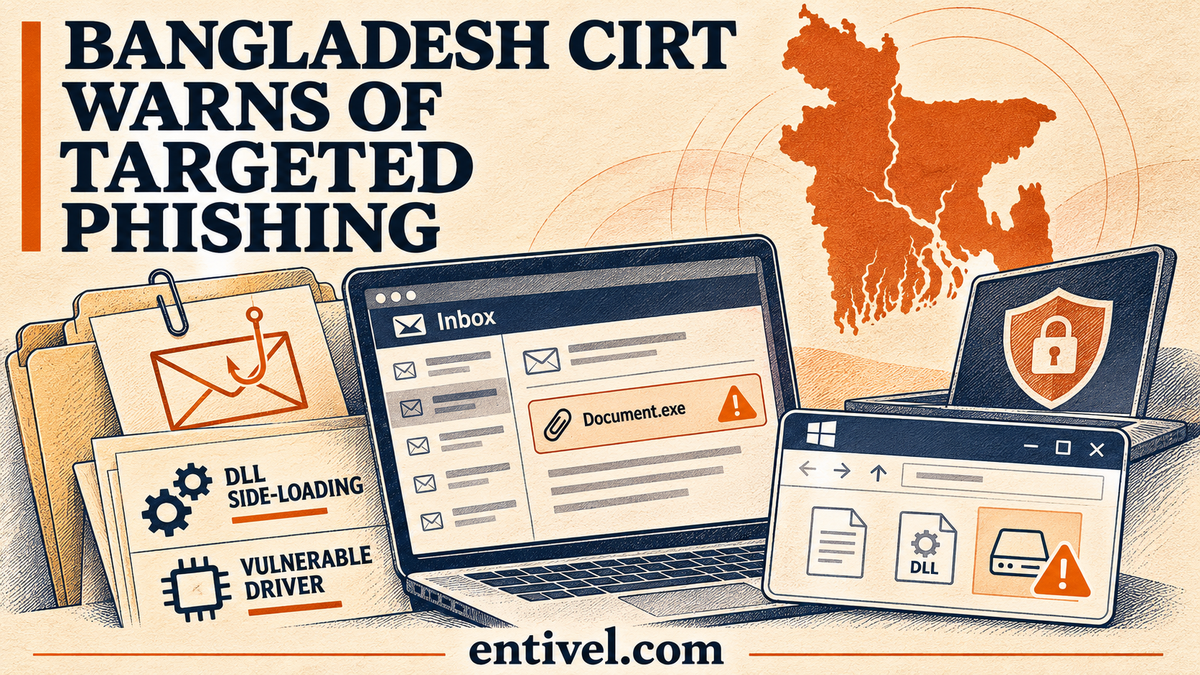
Bangladesh’s national cyber response team has warned government agencies, financial institutions and other critical organisations about a targeted phishing campaign that combines malicious email attachments with techniques designed to evade endpoint security. The notice describes a campaign tracked as FaCai and says the available intelligence does not establish a confirmed compromise of Bangladeshi organisations.
BGD e-GOV CIRT’s 19 November advisory says the emails carry attachments packaged as virtual hard disks, disk images or ZIP archives. The files pair a legitimate, digitally signed executable with a malicious dynamic-link library. If a recipient runs the executable, the malicious DLL can load alongside it, a technique known as DLL side-loading. CIRT says an initial component can download further payloads, including remote-access tools.
The advisory also describes use of a vulnerable kernel driver to try to terminate antivirus and endpoint-detection processes. CIRT identifies an OPSWAT AppRemover driver and CVE-2026-36425 in the activity it analysed. The alert links this tactic to an effort to weaken protections on an affected device; it does not mean every endpoint running security software is vulnerable to this campaign.
CIRT says the activity cluster was identified by Group-IB Threat Intelligence and overlaps operationally with previously reported Silver Fox activity. It cautions that this is an activity-cluster assessment, not definitive proof that the groups are one actor. The advisory does not say that Bangladeshi institutions have been breached. Its local relevance is a warning to organisations in Bangladesh’s government, finance, telecommunications and other critical sectors to assess their exposure.
For defenders, the notice points to several practical checks: scrutinise unexpected disk-image and archive attachments, review whether users can execute files from downloaded or mounted locations, monitor unusual DLL loading, and protect endpoint-security processes from unauthorised termination. Security teams should also review the CIRT advisory’s indicators through their own trusted tools and follow their software vendors’ guidance before blocking or removing files.
From Entivel
Entivel’s Cyber Security Engineering service lists application-security review, secure architecture and identity and access design. Those capabilities can support a scoped review of endpoint, application and access controls. Explore Entivel Cyber Security Engineering.
Sources
Questions about this story? Request a correction or send feedback.