BEA's first SI-economy estimate puts 2024 output at $141.1bn
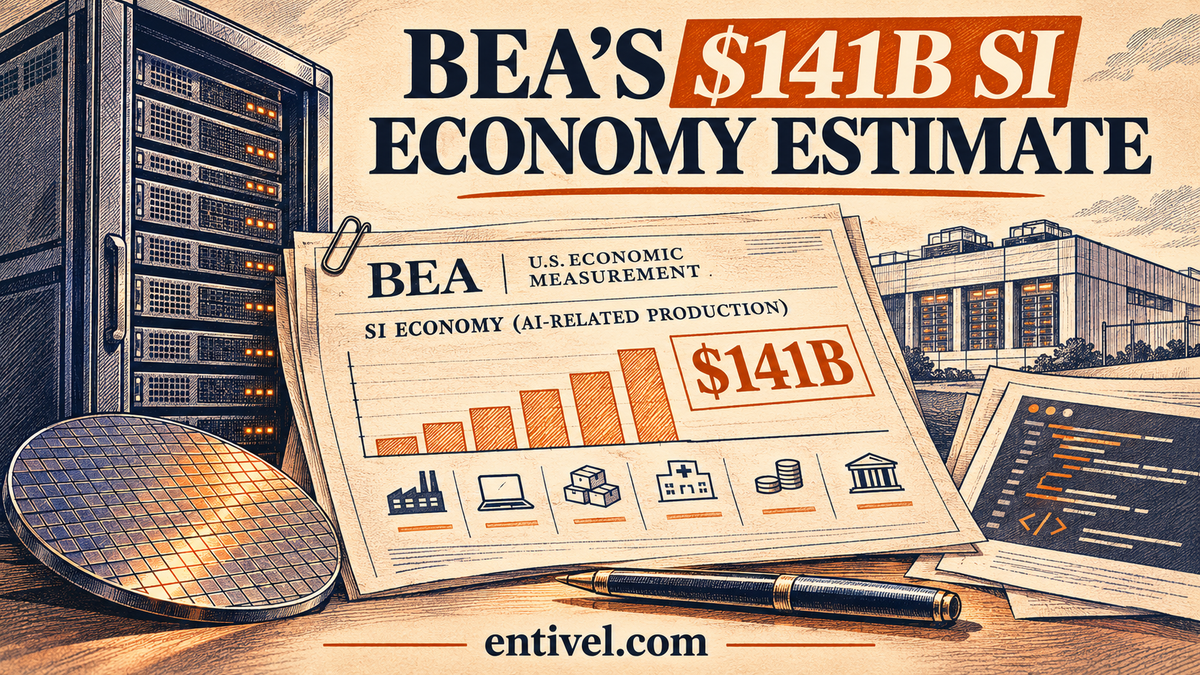
BEA's first experimental estimate values U.S. super-intelligence-related production at $141.1 billion in 2024, or 0.5% of GDP. The measure is national, nominal and subject to revision.
News | 22 November 2026
The U.S. Bureau of Economic Analysis has issued its first experimental estimate of production it calls the “super intelligence” economy, valuing its contribution to U.S. gross domestic product at $141.1 billion in 2024, or 0.5 per cent of GDP. The estimate covers the production and distribution of related goods and services, rather than the productivity effects of businesses using these systems.
The BEA’s November 17 analysis puts the figure at $110.6 billion in 2023 and $141.1 billion in 2024, a 27.6 per cent increase in current dollars. Overall U.S. GDP grew 5.6 per cent in current dollars over the same year. The comparison is nominal: BEA says it does not yet have the price data needed to calculate inflation-adjusted growth for this new measure.
BEA uses “super intelligence” in line with a September 2026 executive order directing federal agencies to replace “artificial intelligence” in their communications. The underlying definition is broader than a narrow group of new products: drawing on the Census Bureau’s definition, the experimental account includes research and development, cloud services, software, data-centre construction, consultancy and engineering, and servers and storage.
Information industries accounted for 44.1 per cent of the measured activity in 2024, while professional and business services accounted for 25.9 per cent. Together they represented 70.1 per cent of the estimate. The data describe a national U.S. measure; BEA has not published a Texas-specific figure in this release.
The agency cautions that the result is experimental. Its methodology supplement explains that no existing product categories isolate this activity in the national accounts. BEA estimates relevant shares using a mixture of public statistics, market reports and company filings. Some government data arrive with long delays, and the agency says it expects to improve the estimates as better data become available. The $141.1 billion figure is therefore a first measurement framework, not a complete census of all related technology or a measure of the gains users receive from adopting it.
From Entivel
Entivel’s AI & Automation service page outlines the company’s work in applying automation and AI systems to business operations. That service information is separate from BEA’s national economic estimate.
Sources: BEA, “Experimental Super Intelligence Economic Statistics, 2024,” 17 November 2026; BEA methodology supplement; Entivel AI & Automation.
Questions about this story? Request a correction or send feedback.