Analysis: Bangladesh Bank widens overseas payment routes
A 9 November Bangladesh Bank circular raises the medical-payment threshold for bank processing and changes specified education and foreign-currency deposit rules.
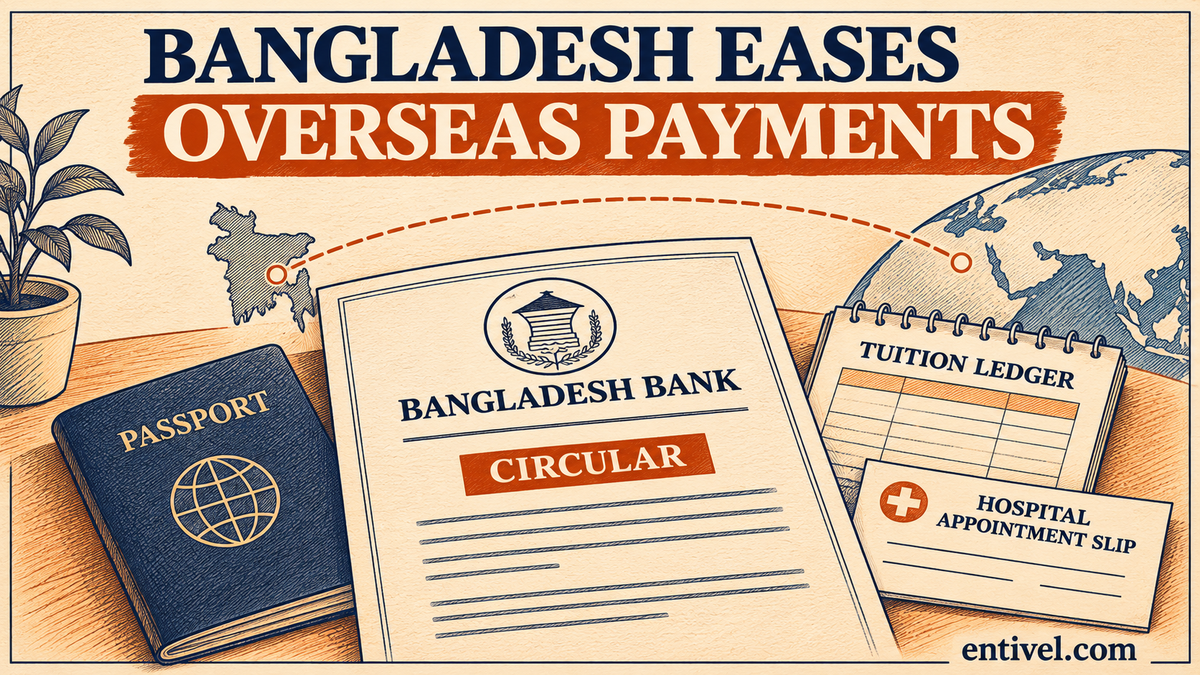
Analysis | 15 November 2026
Bangladesh Bank’s 9 November circular gives authorised dealer banks more room to process specified overseas medical and education payments without seeking case-by-case prior approval from the central bank. The change may simplify some payment routes, but it does not remove the conditions or reporting rules attached to foreign-exchange transactions.
The central bank’s FEPD-2 Circular No. 11 raises the amount an authorised dealer bank may release for medical treatment abroad without prior Bangladesh Bank approval from US$15,000 to US$30,000, or the equivalent in another currency. It amends the bank’s 30 September current-account remittance circular.
For overseas schooling, the circular allows banks to release foreign exchange without prior central-bank approval for secondary- and higher-secondary-equivalent study, provided the availability of free education has been checked. It also extends the no-prior-approval route to regular academic study by correspondence, in addition to certification and professional courses.
A separate provision affects residents bringing foreign currency back into Bangladesh. The circular says the currency can be credited to a Resident Foreign Currency Deposit account only if it was declared to Customs on Form FMJ. The circular states that other relevant instructions remain in force.
Together, the changes shift specified checks closer to the authorised dealer bank handling the transaction while retaining defined limits and conditions. That distinction matters: a higher threshold for medical payments is not an open-ended permission for every outward transfer, and the education provision is conditional. The rule also links expanded outward-payment options with a clear declaration requirement for qualifying foreign currency deposited on return.
For families and bank operations teams, the practical issue is process clarity: which documents a bank needs, how it checks whether free education is available, and how it records declarations for RFCD deposits. Bangladesh Bank’s circular lists the changes but does not announce a blanket relaxation of the wider foreign-exchange framework.
From Entivel
Organizations that manage policy-driven workflows can explore Entivel Workspace, which connects operational records, approval policies, documents and audit evidence across business functions. It is a general enterprise platform, not a Bangladesh Bank compliance product.
Source: Bangladesh Bank, FEPD-2 Circular No. 11, 9 November 2026.
Questions about this story? Request a correction or send feedback.