Australia's unemployment rate reaches 4.9%, highest since 2021
The ABS October labour-force release puts seasonally adjusted unemployment at 4.9%, the highest since 2021, while trend employment was broadly steady and monthly changes remain subject to sampling variability.
News | 19 November 2026
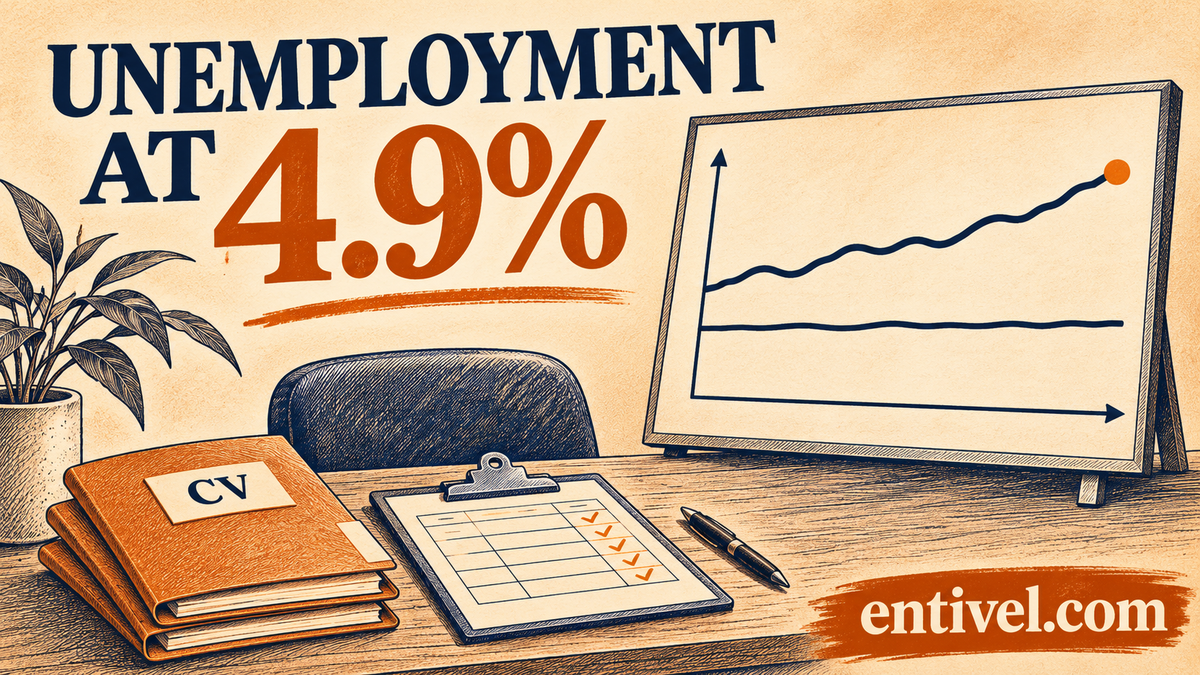
Australia's seasonally adjusted unemployment rate rose to 4.9% in October, its highest level since October 2021, while the underlying trend measure showed employment broadly steady. The latest Australian Bureau of Statistics release and its October data tables put the headline labour market measures in different directions rather than describing a sudden shift across every indicator.
The ABS counted 753,700 unemployed people in seasonally adjusted terms, 17,800 more than in September. Employment fell by 43,500 to 14.74 million. The unemployment rate rose 0.1 percentage point from 4.7% to 4.9%. That makes the 4.9% level notable in the post-pandemic series, but the one-month change needs context.
In its October survey methodology, the ABS gives a typical-month 95% confidence interval of -109,500 to 22,500 for the employment movement and -0.1 to 0.3 percentage points for the unemployment-rate movement. Both ranges include no change. The monthly estimates are therefore subject to sampling variability and should not be read as precise counts of the change in the whole workforce.
The ABS trend series, which smooths short-term movement, showed employment increasing by 7,200 people, or 0.0% when rounded, and the trend unemployment rate rising to 4.8%. This contrast is important: the seasonally adjusted series records a weaker month, while the trend series points to little underlying employment growth. Neither measure on its own says what caused the changes or predicts what employers will do next.
Other indicators were mixed. The participation rate fell 0.2 percentage points to 66.6%, and monthly hours worked declined 0.2%. Underemployment edged down to 6.2%, while youth unemployment rose to 11.3%, its highest rate since October 2021. These measures cover different aspects of work: the unemployment rate counts people without a job who are seeking and available for work; underemployment captures employed people who want and are available to work more hours.
The ABS also flagged survey composition for state-level readers. It adjusted the influence of about 1,390 respondents, 2.7% of the October sample, in one Victorian rotation group, and noted a higher unemployment rate in South Australia's incoming group. These points warrant care when interpreting jurisdictional movements; they do not change the reported national headline.
From Entivel
For employers managing changing staff schedules, Entivel Workforce provides employee records, rostering, attendance and leave-management tools. Explore Entivel Workforce.
Questions about this story? Request a correction or send feedback.