Australian red meat output falls as beef production drops
Australian red meat production fell in the September quarter, but ABS data shows different trends across beef, lamb, mutton, pork and chicken.
News | 18 November 2026
Australian red meat production fell 2.8% in the September quarter, with beef output leading the decline while several other meat categories moved in the opposite direction. The Australian Bureau of Statistics reported a 4.7% seasonally adjusted fall in beef production to 740,002 tonnes, alongside a 4.6% drop in cattle slaughter to 2.4 million. Read the ABS September-quarter release.
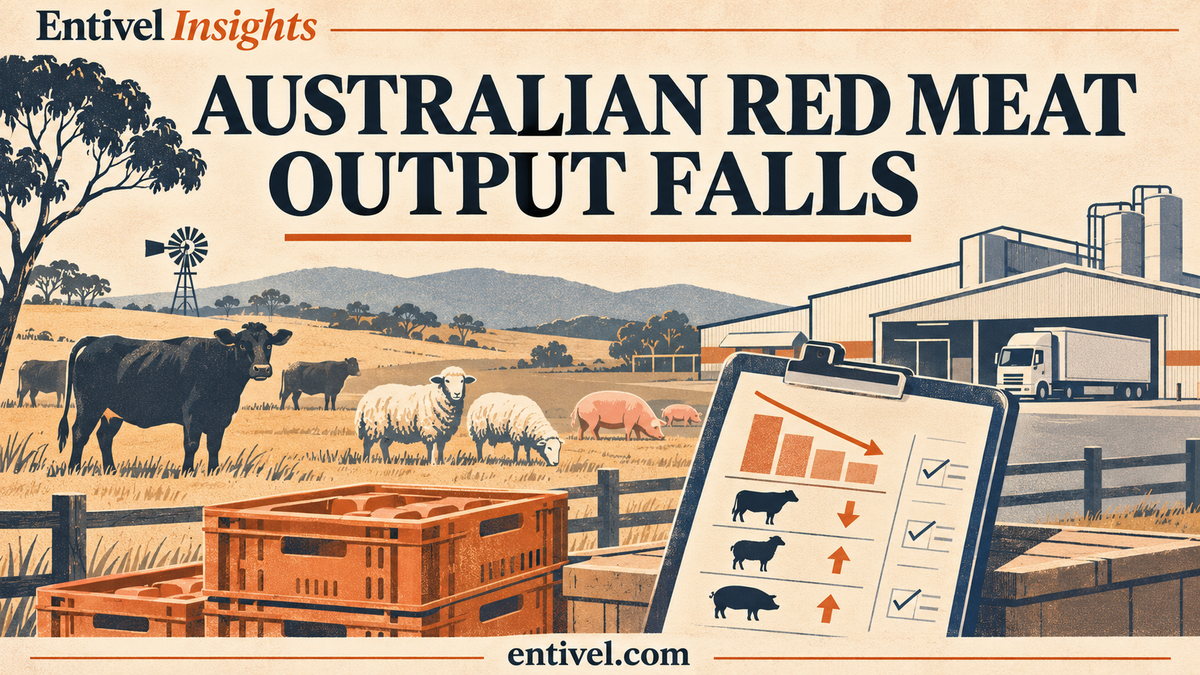
The mix differed by species. Sheep slaughter increased 4.4% to 1.5 million and mutton production rose 7.6% to 42,976 tonnes. Lamb production increased 1.0% even as lamb slaughter fell 1.0%. Pig-meat production advanced 2.0%, while chicken-meat production decreased 1.6%. The figures show a varied quarter rather than a uniform decline across meat production.
Quarterly comparisons need context: the seasonally adjusted ABS table puts September-quarter beef production at 740,002 tonnes, compared with 724,500 tonnes in September 2025 and 776,800 tonnes in June 2026. Calculated from those published values, the latest figure was about 2.1% above the same quarter a year earlier while remaining below the prior quarter. The next livestock-products release is scheduled for 19 February 2027.
What the production figures do and do not show
The ABS series covers livestock and poultry slaughter at registered abattoirs and meat produced for human consumption. It draws on quarterly surveys of commercial abattoirs and meat processors, with data available nationally and by state and territory. The figures do not, by themselves, show retail prices, export volumes, inventories or the amount of product available to a particular buyer.
For processors, wholesalers and food-service buyers, the species-by-species detail is more informative than the combined red-meat headline. It helps describe recent throughput; it does not forecast the next quarter or establish why production changed. Any effects on supply contracts or customer prices would depend on additional factors that this release does not measure.
From Entivel
Entivel Workspace connects supplier, procurement, receiving, inventory and finance records in one operating context. It is an enterprise workflow platform, not a livestock-market forecast. Explore Entivel Workspace.
Sources
Questions about this story? Request a correction or send feedback.