
The accessibility of powerful enterprise technology has historically been gated by capital expenditure. Only the largest multinational corporations could afford bespoke AI solutions, advanced CRM suites, and robust cybersecurity infrastructure. This dynamic created a significant operational gap between market leaders and smaller enterprises. However, recent developments, such as Salesforce integrating sophisticated artificial intelligence capabilities for small businesses within the Gulf Cooperation Council (GCC) region through partners like ZAWYA, mark a profound inflection point. These localized deployments are not merely regional successes; they represent the global normalization of enterprise-grade AI access, fundamentally altering the competitive playing field for Small to Medium Enterprises (SMEs) worldwide.
What Happened: The Convergence of Enterprise Power and SME Reach
At its core, the event highlights a successful model where a market leader in Customer Relationship Management (CRM), Salesforce, has successfully scaled advanced AI functionality down to be highly usable by smaller organizations. Historically, enterprise-level AI required specialized data science teams and substantial IT overhead,resources typically reserved for Fortune 500 companies. The strategic partnership with ZAWYA facilitated the deployment of these sophisticated tools into numerous SMEs operating within a major economic hub.
The functionality being delivered goes far beyond basic automation. It involves embedding predictive analytics, intelligent workflow orchestration, and generative AI directly into the operational backbone of the business. For an SME owner or manager, this means that complex tasks,such as predicting customer churn, automating personalized marketing content at scale, or optimizing internal resource allocation,are no longer theoretical goals but integrated features within their existing software stack. This level of accessibility is key: it takes world-class functionality and packages it into a manageable, scalable solution tailored for the needs and budgets of growth-stage businesses.
Why It Matters: Global Implications for International Business Strategy
For international business leaders operating outside the GCC region, this trend signals a critical shift in operational parity. The primary takeaway is that sophisticated AI capabilities are rapidly becoming commodities, no longer exclusive luxuries. This democratization has three major implications:
The Compression of the Capability Gap
Previously, a large corporation maintained an advantage over a smaller competitor simply by having superior technology adoption. Now, because platforms like Salesforce can embed predictive AI into affordable SME packages, the technological gap is shrinking rapidly. The differentiator shifts from *having* the technology to knowing how to *apply* it. International businesses must therefore move away from viewing tech investment as a pure cost center and instead treat it as an intelligence multiplier.
Elevated Operational Expectations
The ability for SMEs in key markets to achieve enterprise-level efficiency sets a new baseline expectation globally. When smaller competitors can offer customer experiences, operational speeds, and data insights previously associated only with global giants, the entire market recalibrates. International firms must anticipate that their smaller rivals will be operating at a far higher level of optimized complexity than they were even five years ago.
The Necessity of Integrated Ecosystems
This model emphasizes integration over standalone tools. The value is not derived from buying an AI chatbot or a separate analytics platform; the value lies in how that AI speaks to the CRM, which talks to the accounting system, and so on. International businesses must prioritize vendor ecosystems that promise seamless data flow and interoperability, rather than simply chasing the newest single-function application.
What To Do Next: Strategic Recommendations for Global Enterprises
For international business leaders,especially those managing or planning growth in emerging markets,the trend dictates a proactive shift in strategy. Simply buying software is insufficient; strategic adoption requires process overhaul and workforce upskilling.
1. Conduct a Process Audit, Not Just a Tech Audit
Before implementing any new AI tool, global businesses must conduct a meticulous audit of their existing workflows. The goal is not to see where technology fails, but to identify the bottlenecks, redundancies, and manual handoffs that create friction. Advanced AI excels at optimizing processes, but it requires clean, standardized data inputs and clearly defined decision points. Focus first on streamlining the process; the technology will follow.
2. Adopt a Phased, Modular AI Implementation
Avoid the temptation of 'rip-and-replace' projects. Instead, adopt a modular approach. Identify one critical pain point,perhaps lead qualification or inventory forecasting,and apply an advanced AI solution to solve *only* that problem perfectly. Measure the ROI rigorously. Once proven successful, layer the next module on top. This reduces risk, builds internal confidence in the technology, and ensures measurable value at every stage of adoption.
3. Invest in Data Governance and Security First
The power of these AI tools is directly proportional to the quality and volume of data they consume. As international businesses integrate more sophisticated systems, their attack surface expands dramatically. Therefore, cybersecurity cannot be an afterthought or a bolted-on add-on. Budget for robust data governance frameworks from day one. Ensure that all new AI integrations adhere to global compliance standards, maintaining customer trust while maximizing analytical potential.
In conclusion, the advancements seen in regional markets like the GCC are providing a clear blueprint for global operational resilience. The days of massive technological barriers separating market leaders and growing SMEs are fading. For international businesses, success moving forward hinges on adopting an AI-first mindset: prioritizing process optimization, demanding seamless integration, and treating data governance as the most valuable asset of all.
How Entivel can help
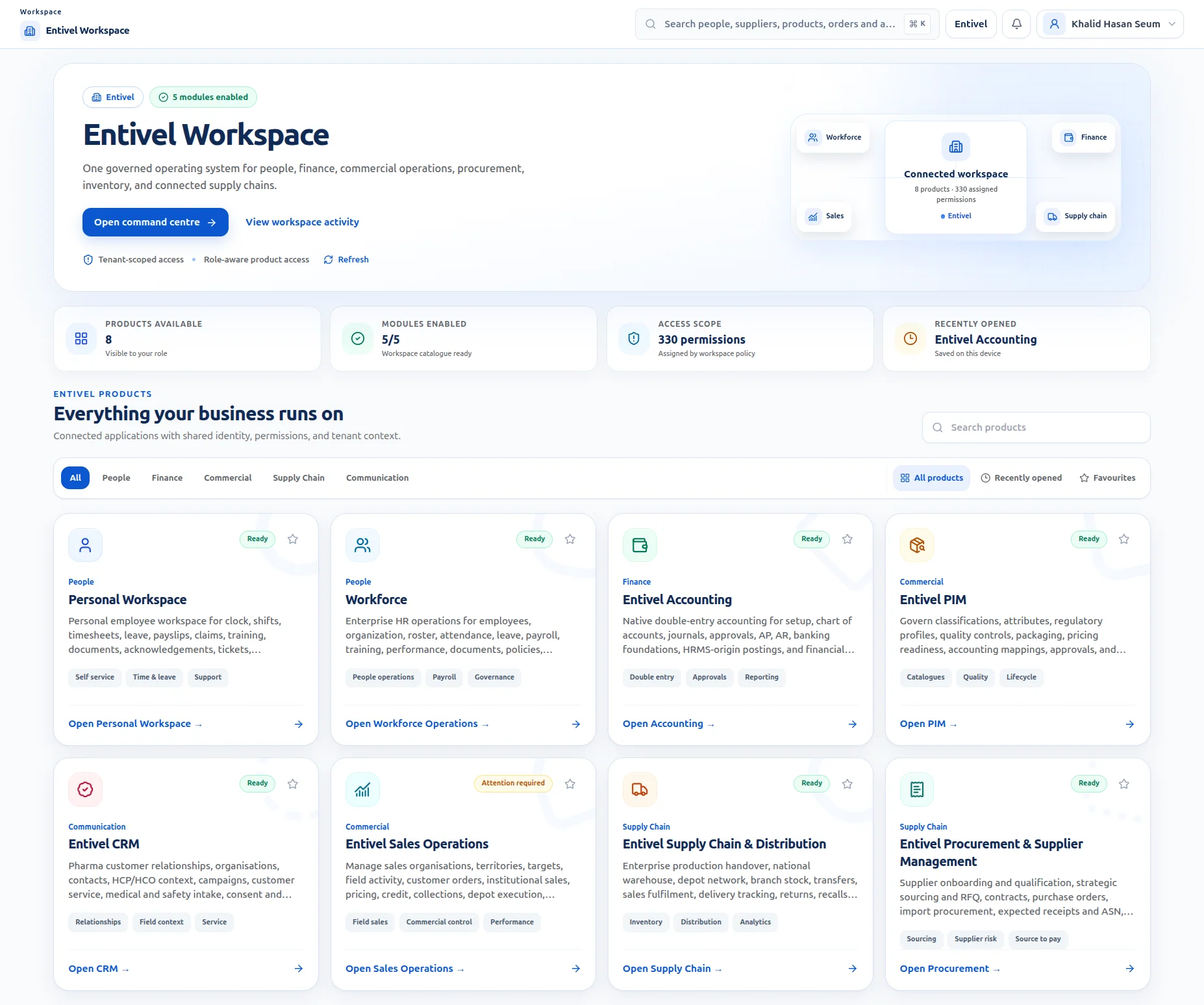
Entivel helps businesses identify manual workflows that can be automated with secure AI-powered systems. Learn more at https://entivel.com.