
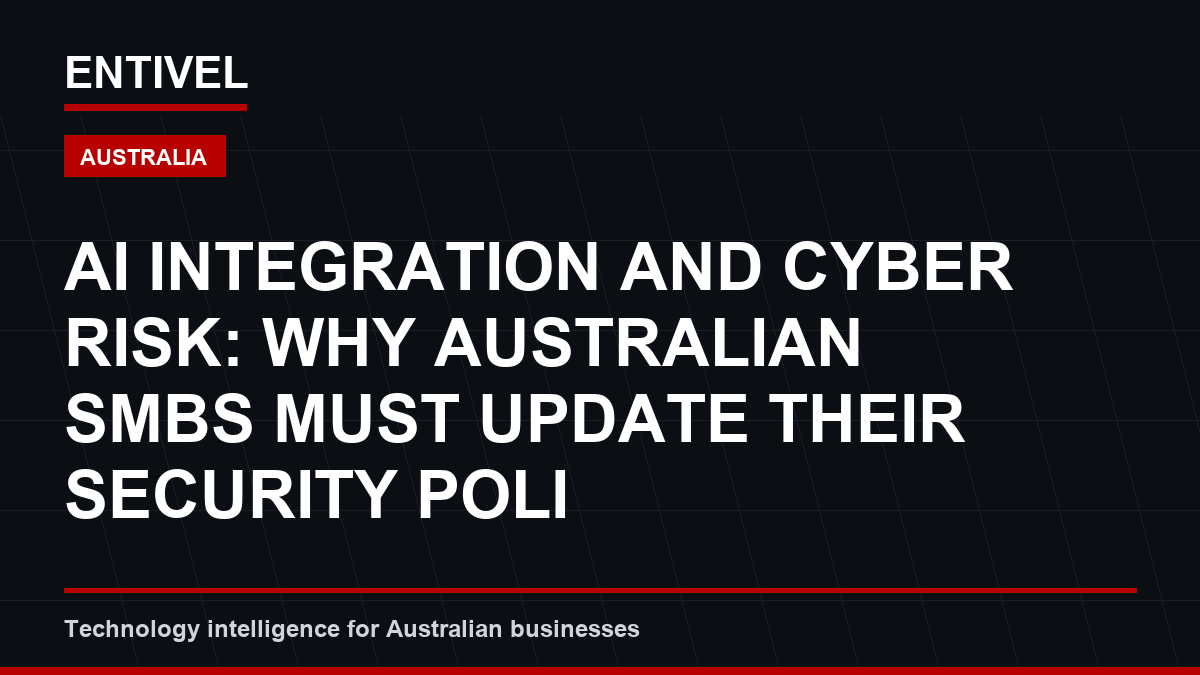
The speed of technological adoption has never been faster. For Australian small to medium businesses (SMBs), AI tools,from automated customer service chatbots to advanced data analysis platforms,offer unprecedented efficiency gains. However, this rapid integration comes with a critical warning: the cybersecurity policies designed for yesterday’s challenges are often insufficient for today’s connected, AI-driven environment. CPA Australia highlighted this vulnerability recently, urging business owners to treat their cyber security protocols not as static compliance documents, but as living operational guidelines.
The New Cyber Risk Profile: Where Generative AI Changes the Game
For many SMBs, cybersecurity is viewed through a lens of perimeter defence,firewalls, anti-virus software, and access controls. While these elements remain foundational, the proliferation of third-party generative AI tools has fundamentally altered the threat model. The risk is no longer just about malware entering the network; it is increasingly about data leakage and improper handling outside controlled systems.
When an employee inputs proprietary client data or sensitive business strategies into a public-facing LLM (Large Language Model), that information leaves the secure corporate perimeter. While AI tools are marketed for their convenience, they introduce unique vectors of risk:
- Data Exfiltration: Unchecked use of AI can inadvertently upload confidential client lists or intellectual property to external models, making that data accessible to third parties.
- Prompt Injection Attacks: Malicious actors can manipulate integrated systems (like internal chatbots) by crafting deceptive prompts, forcing the system to reveal sensitive information or execute unauthorized commands.
- Policy Gaps: Most existing Acceptable Use Policies (AUPs) were written before widespread AI adoption. They may not contain specific rules governing what data types can be processed by non-vetted external tools, leaving a critical governance gap.
Why Policy Review is Non-Negotiable for Australian SMBs
For the average business owner in Australia, compliance often feels like an insurmountable administrative burden. However, ignoring policy updates when adopting new technology is akin to installing powerful but unsealed windows on your office building,the vulnerability is obvious, yet overlooked.
The core issue isn't whether SMBs can afford advanced security systems; it is about implementing robust governance around the *people* and the *processes*. The human element remains the weakest link. If staff do not understand that using a public AI model with client data violates company policy,and potentially breaches privacy laws like GDPR or local Australian regulations,the best technical controls will fail.
Furthermore, regulatory expectations are shifting. As cyber incidents become more common and sophisticated, professional bodies advising SMBs are rightly pointing out that due diligence requires proactive governance. A comprehensive risk audit must now include an assessment of how AI tools are integrated into the workflow, treating each tool as a potential data gateway.
Three Actionable Steps to Fortify Your Defences Today
Updating policies is not just about printing a new document and having everyone sign it. It requires embedding security considerations into your operational DNA. Here are three critical areas for Australian SMBs to focus on immediately:
1. Revamp the Acceptable Use Policy (AUP)
The AUP must be AI-specific. It needs clear, non-ambiguous rules regarding data input. Instead of general statements like “Do not share confidential information,” policies should state: “Client names, account numbers, and proprietary financial models must never be entered into public generative AI tools.” Consider implementing a 'Clean Data' protocol,staff must understand how to sanitize data before external use.
2. Conduct a Third-Party Vendor Risk Assessment
Every time your business adopts an AI tool, you are introducing a third party onto your risk ledger. Before signing up for any new SaaS or automation platform, demand clarity on their data residency, encryption standards, and how they guarantee that your inputs will not be used to train their models without explicit consent. This level of vetting is crucial for maintaining compliance and trust with Australian clients.
3. Implement Targeted AI Security Training
Generic cybersecurity awareness training is no longer enough. Staff need practical, scenario-based training focused on generative AI misuse. Training should cover:
- Identifying Hallucinations: Teaching staff to treat AI outputs as drafts requiring human verification, rather than definitive truth.
- Source Verification: Understanding the risk of AI generating convincing but entirely false information (hallucination) and how that can damage client relationships or legal standing.
- Prompt Engineering Security: Training employees on how to write prompts that minimize data exposure while maximizing utility.
Conclusion: Cybersecurity as Operational Adaptation
For Australian businesses, the message is clear: cybersecurity resilience in the AI era demands continuous adaptation. It requires moving beyond reactive patching and adopting a proactive governance framework. By treating policy review as an operational necessity,a critical part of maximizing your technological investments while minimizing exposure,SMBs can harness the power of AI safely, maintaining their reputation and ensuring compliance in this rapidly evolving digital landscape.
How Entivel can help
Entivel helps businesses review website security, access control, cloud exposure and software risk before small issues become expensive incidents. Learn more at https://entivel.com.